

Category: Opinion & analysis
Inside the left’s push to reshape 2028 with ranked-choice voting
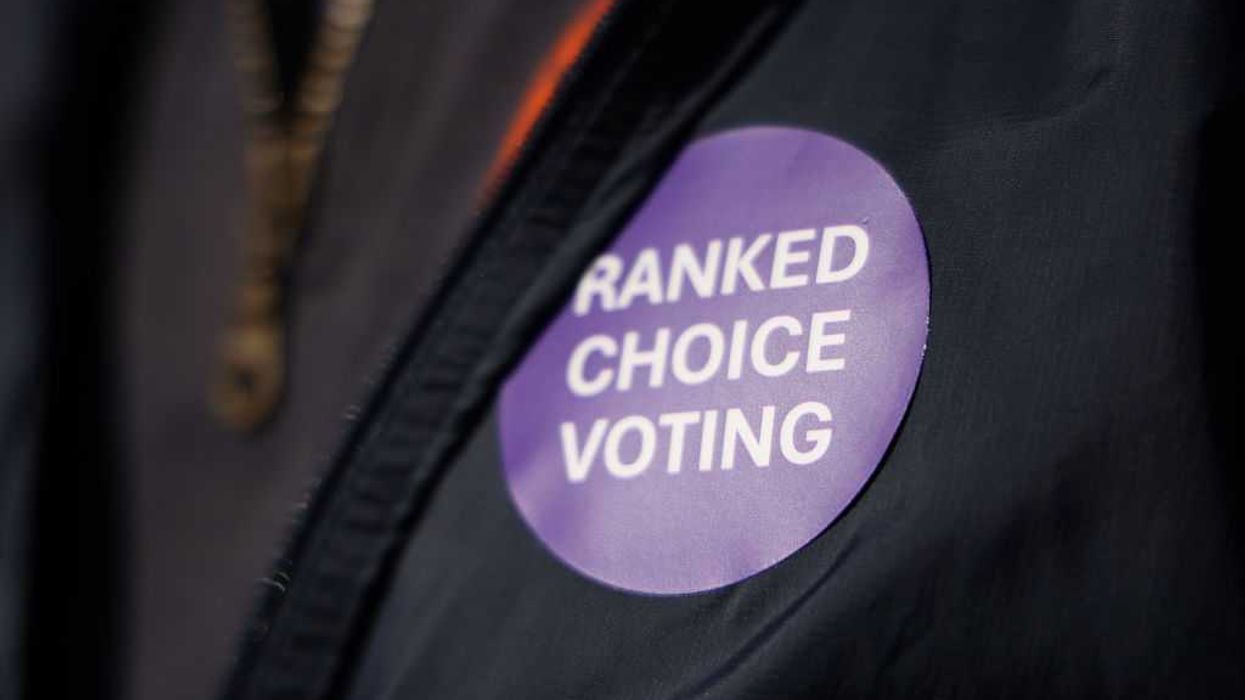
If Democrats seem extreme now, wait until they adopt ranked-choice voting. Some activists inside the party want exactly that — a reform that would push presidential nominations even further left and force establishment figures to navigate an ideological gauntlet to win.
Multiple reports indicate that Democratic Party activists and elected officials are pressuring the party to adopt ranked-choice voting for its 2028 presidential primaries. Axios notes that the push has grown serious enough that top party officials met in late October with advocates including Rep. Jamie Raskin (D-Md.), pollster Celinda Lake, and representatives from FairVote Action.
Ranked-choice voting would pour accelerant on a process already pulling Democrats further left.
Such an effort fits a long pattern: For decades, Democrats have shifted presidential nominations away from party leadership. On ranked-choice voting specifically, several states already use it — Maine and Alaska among them — along with deep-blue cities such as New York, Minneapolis, San Francisco, and Seattle.
Ranked-choice voting takes multiple forms, but New York City’s model illustrates the dynamic. Voters rank up to five candidates. If no candidate wins an initial majority, the last-place candidate drops out, and those voters’ second-choice votes are redistributed. This “loser leaves” process continues until a candidate secures a majority.
Assuming rational behavior, Democratic voters would likely rank candidates from more extreme to less extreme. That pattern would advantage the leftmost candidates again and again as lower-preference votes transfer upward.
This structural boost would encourage both supply and demand for extreme candidacies. Candidates on the ideological edge would have more incentive to run. Voters who prefer them would have more influence. Ranked-choice voting’s supporters tout this expanded participation as a virtue.
Offering voters multiple choices would foster coalition-building. Knowing the race may go to multiple rounds, candidates would angle for second- and third-choice votes. The horse-trading once done in old convention “smoke-filled rooms” would unfold publicly through a series of ranked ballots.
But the key question is simple: Why would ranked-choice voting necessarily supercharge extremism inside the Democratic Party? Because the system rewards voters for casting marginal votes — and among today’s Democrats, “marginal” means “further left.”
The party’s ideological shift is measurable. In Gallup’s 2023 polling, 54% of Democrats identified as liberal — an all-time high. Support for democratic socialists in major-city mayoral primaries shows how rapidly the party’s activist base has moved left. In 1995, the liberal share of the party was 25%, roughly equal to conservatives. Three decades later, conservatives make up just 10% of Democrats.
Exit polling confirms the trend: In 2024, 91% of self-identified liberals voted for Kamala Harris; only 9% of conservatives did.
Extrapolate from this trajectory, and the danger becomes even clearer. Extreme candidates increasingly win Democratic primaries in major cities. Those cities dominate statewide Democratic politics. And in closed primaries, only Democrats vote — meaning the hyper-engaged activist left already sets the terms of competition. Ranked-choice voting would amplify that influence. The same voters who nominated democratic socialists in New York and Seattle would wield disproportionate power in a presidential contest.
RELATED: Democrats are just noticing a long, deep-running problem
 Photo by RYAN MCBRIDEDON EMMERTDON EMMERTKENA BETANCURROBYN BECKANGELA WEISSROBYN BECKROBYN BECKROBYN BECK/AFP via Getty Images
Consider how the 2020 Democratic primary might have played out under ranked-choice voting. Joe Biden — an establishment candidate favored by moderates — would have faced a field dominated by Bernie Sanders, Elizabeth Warren, Pete Buttigieg, Tom Steyer, and others to his left. Ranked-choice voting would have forced him through a gauntlet designed by the party’s most ideological voters.
This trend is not new. In 1972, George McGovern reshaped Democratic nominating rules and then benefited from the changes. Since then, the party has repeatedly weakened its establishment’s role (with key exceptions). Ranked-choice voting would accelerate that shift dramatically.
With moderates now only 36% of the party, according to Gallup, how could they resist a move toward ranked-choice voting? More importantly, which remaining moderate or establishment Democrat could survive a ranked-choice system dominated by the party’s left wing?
Ranked-choice voting would pour accelerant on a process already pulling Democrats further left. The only question is how long it takes for the party to adopt it — and how long the party can remain viable nationally if it does.
Trump cracks the Caracas cartel code

Democrats deny what mountains of evidence have long shown: Terrorist groups traffic in illegal drugs.
Rep. Jim Himes (D-Conn.) recently insisted, “There is no such thing as a narco-terrorist,” as he defended his opposition to the Trump administration’s war on narco-terrorism in the Caribbean. He accused the administration of trying “to make this look like it’s ISIS or Al-Qaeda,” ignoring that ISIS, Al-Qaeda, Hezbollah, and similar groups have long run profitable drug operations with local and transnational cartels. These alliances increased revenue, financed attacks, fueled violence, and deepened existing conflicts.
Maduro’s narco-terrorist regime threatens regional stability and US national security. Trump’s war on narco-terrorism meets that threat head-on.
Narco-terrorism did not originate with the Trump administration. It was the subject of my 1990 book, which documented how governments around the world used the drug trade to fund and advance terrorist activity. For more than three decades, Washington looked away. That era has ended.
On November 16, the U.S. Treasury designated Venezuela’s Cártel de los Soles — run by Venezuela President Nicolás Maduro and key figures in his illegitimate regime — along with Tren de Aragua and the Sinaloa Cartel, as foreign terrorist organizations. Treasury should have added Colombia’s National Liberation Army (Ejército de Liberación Nacional, or ELN), a Marxist paramilitary and major drug-trafficking force that controls both sides of the border and works closely with Maduro.
When I began researching narco-terrorism in 1986, I assumed political groups across the spectrum could use terror and drug trafficking to advance their aims. The evidence showed otherwise. Marxist-Leninist and Islamist regimes, movements, and militias initiated, expanded, and ultimately dominated this trade.
Venezuela’s slide into narco-terrorism dates to 2005, when Hugo Chávez expelled the U.S. Drug Enforcement Administration. After Chávez died in 2013, Maduro took control of both the government and the drug enterprise, tightening his partnership with Iran and its Lebanese proxy, Hezbollah, under the so-called Axis of Resistance. The goal is to counter U.S. influence in Latin America and the Middle East while enriching the regime.
Maduro’s alliance with Iran and Hezbollah runs deep. He offers sanctuary and support for their narcotics networks, money laundering, weapons pipelines, and terrorist smuggling throughout the region.
RELATED: Turns out that Hegseth’s ‘kill them all’ line was another media invention
 Photo by Anna Moneymaker/Getty Images
Hugo “El Pollo” Carvajal — a former three-star Venezuelan general under Chávez and Maduro and a former member of Cártel de los Soles — described the strategy bluntly in a letter to President Trump. “The purpose of this organization is to weaponize drugs against the United States,” he wrote. “The drugs that reached your cities through new routes were not accidents of corruption nor just the work of independent traffickers; they were deliberate policies coordinated by the Venezuelan regime against the United States.”
This collaboration, built over decades, helped millions of Americans fall into addiction and contributed to hundreds of thousands of deaths.
Maduro’s narco-terrorist regime threatens regional stability and U.S. national security. Trump’s war on narco-terrorism meets that threat head-on and is perfectly just.
Shock poll: America’s youth want socialism on autopilot — literally
Growing up during the fall of the Berlin Wall and the collapse of the Soviet Union, I remember when socialism was a universal punch line. It stood for failure, repression, and economic ruin.
Not any more. Today, socialism is the ideological spearpoint of the left. Many young Americans now insist that socialism is the cure for the affordability crisis squeezing them. They believe it with a fervor that would have stunned earlier generations.
The evidence is overwhelming, and the verdict is final: Socialism fails everywhere it is tried. Now imagine that system fused with an all-seeing AI.
New polling from Rasmussen Reports and the Heartland Institute’s Emerging Issues Center shows that a majority of likely voters ages 18 to 39 want a Democratic Socialist to win the White House in 2028.
Nearly 60% of young Americans say they support more government housing, a nationwide rent freeze, and government-run grocery stores in every town.
These numbers aren’t anomalies. They reflect a deeper reality: Many young Americans know little about socialism’s actual history, consequences, or track record — and they have been conditioned to believe it can fix the challenges in front of them.
One reason for that ignorance is uncomfortable but obvious. It’s not only the schools — it’s the parents. According to the polls, parents were the most influential voices shaping their children’s support for Democratic Socialism. More than half of respondents said their parents held a favorable view of it.
That alone explains a great deal. And unsurprisingly, more than half also said teachers and professors viewed Democratic Socialism favorably. After decades of ideological drift, even parents who grew up after the USSR’s collapse now believe socialism “might work.”
Based on my own experience teaching in public schools, that rings true. Most of my colleagues openly sympathized with the socialist cause and were hostile to free-market capitalism.
This didn’t happen by accident. It reflects a long march beginning in the Progressive Era. My own postgraduate experience at a prestigious teaching college felt less like preparation for the classroom and more like a Cultural Revolution struggle session — conformity required, dissent punished.
As the public education system drifted leftward, it taught generation after generation that socialism is benevolent and capitalism is predatory. The result is predictable. Many young people now see the free market as the enemy, not the mechanism that lifted billions out of poverty. Cronyism and the explosion of government power only blur the picture further.
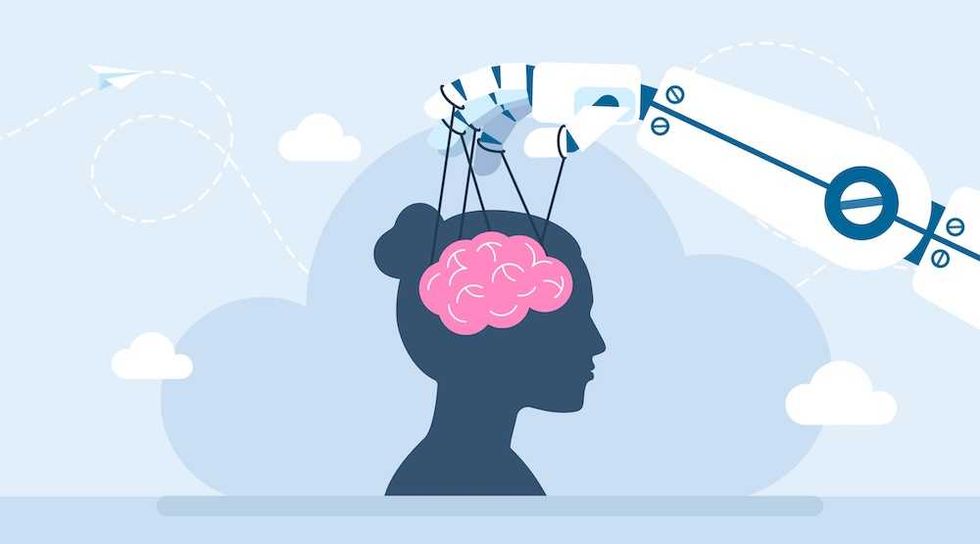
Layer onto this the collapse of basic literacy and numeracy. When students can’t read well, struggle with math, and can’t write a coherent paragraph, they are more vulnerable to ideological manipulation — and more likely to lean on machines to think for them.
So it shouldn’t shock anyone that almost half of young Americans surveyed want an advanced AI system to create society’s laws, rules, and regulations. Nearly 40% want that AI system to determine human rights and control the world’s most powerful militaries.
RELATED: Almost half of Gen Z wants AI to run the government. You should be terrified.
 Yurii Karvatskyi via iStock/Getty Images
How did this happen? Watch how many parents are glued to screens, outsourcing daily life to devices. Is it any wonder their children grow up thinking technology is omnipotent?
Parents should start with something simple: a family movie night featuring the “Terminator” franchise. Let the kids see where blind faith in machines tends to lead.
Better yet, teach them the truth about socialism. Teach them what it does to human beings. Share the books, documentaries, and testimonies exposing socialism’s century of famine, repression, forced labor, and mass murder — horrors still unfolding in Cuba and North Korea.
The evidence is overwhelming, and the verdict is final: socialism fails everywhere it is tried. Now imagine that system fused with an all-seeing AI — a surveillance state that Stalin could only dream of. The thought of an AI-run socialist regime is not dystopian fiction. It is what many young Americans say they want.
They should be careful what they wish for.
Why the kids are not all right — and Boomers still pretend nothing’s wrong

Here’s a message Baby Boomers need to hear: The America you were born into no longer exists.
A rising tide of young Americans are embracing socialism at a pace this country has never seen. Boomers often assume that it’s about handouts. It isn’t. Beneath the surface is a decades-long campaign so destructive to middle-class mobility that it threatens to push the nation toward civil conflict. The more you study it, the more coordinated it looks.
A people dependent upon ‘gimme gimme’ socialism is an easily managed population. A demoralized middle class keeps the ruling class secure.
In a way, it was.
Short-term profit-maximizing globalists on Wall Street teamed up with the K Street lobbying blob to drown Americans in cheap Chinese goods while saddling them with student debt, consumer debt, and medical debt.
Young people are being priced out of the American dream.
My urgent message to Boomers — especially those who want to keep influence: The kids are not all right.
The America your kids and grandkids know is not the America you knew. Most Boomers were born in the 1950s, when the country was booming — united by postwar optimism, American industrial strength, shared national institutions, Walter Cronkite on one television in every home, full-fat milkshakes, and Elvis shaking up the culture.
Today, we live in a golden age of technological revolution. We are making remarkable advances in space travel, tech, and medicine — increasingly led by the private sector and unapologetic capitalists. But on the basics — housing, health, education — we’re failing the next generation.
In 1955, the median homebuyer was in his late 20s. In 2025, it’s 56. A minimum-wage worker in the 1950s needed roughly seven years of pay to buy a modest home without a mortgage. Today, it’s around 27.
In 1955, a student could pay college tuition by working a few hours a day at minimum wage. Today, that same student would need to work about six hours a day. If a kid wants Yale or any Ivy League school, he would have to work 26.4 hours a day — an impossible figure that illustrates how detached elite education has become from reality.
Here’s a frightening divide: 93% of Boomers say political violence is never justified; 44% of Gen Z say it “sometimes” is.
Ninety-nine percent of kids are not out for blood, but 100% of them face a massive relative disadvantage. The upward mobility Boomers took for granted has been hollowed out by globalist and left-wing policies sold as progress but experienced as decline.
We spent trillions of American dollars on foreign wars, foreign infrastructure, and foreign elections. We borrowed recklessly. Now the dollar is frail. We allowed millions of illegal migrants to enter the country, fueling crime and pushing Americans out of jobs. Young households are buried in debt — not mortgage debt that builds equity, but consumer debt used to numb the anxiety left by a collapse in community and faith.
Here’s the truth: The populist right and the socialist left agree on the diagnosis. Listen to the first half of Bernie Sanders’ interview with Joe Rogan in June. For an hour, Bernie describes America’s economic troubles. Most people, right or left, would nod along.
Then comes the pivot: Socialism is the cure.
This is the left’s great deceit. Progressives’ proposed “solutions” hurt the very people they claim to help.
RELATED: We built abundance and lost the thing that matters
 Photo by Spencer Platt/Getty Images
Take restrictive zoning and rent regulations — blue-state staples designed to “create” affordable housing. In reality, they choke supply and drive rents higher. Or look at no-cash bail. The neighborhoods hit hardest by serially released offenders are the same minority communities progressives claim to champion. The examples pile up.
So why do left-wing billionaires back these ideas? Simple: Socialism, communism, and their logical end point — fascism — are excellent for entrenched oligarchs. A people dependent upon “gimme gimme” socialism is an easily managed population. A demoralized middle class keeps the ruling class secure.
There is another path.
We must reverse the policies that got us here. Strengthen education outcomes, lower health care costs, rebuild domestic supply chains, expand American energy generation, and restore competence to the workforce.
Boomers, if you don’t lead this shift, your influence will vanish before your next Social Security check arrives. Moderate Democrats already know the socialist tide is rising. They’re afraid to say it out loud.
The Gen Z and Millennial voting bloc will dominate the 2028 election. They are demanding change. Moderates — in both parties — are being replaced by extremists.
You have a choice: Allow yourselves to be absorbed into the socialist machine, or correct the mistakes of the last two decades, return power to citizens, and rebuild access to the American dream.
The Supreme Court takes up New Jersey’s baseless assault on pro-life support for moms
New Jersey Attorney General Matthew Platkin’s office was recently forced to make a stunning admission before the U.S. Supreme Court. During oral arguments, Platkin’s team conceded that although the state issued a sweeping subpoena against a pregnancy center — First Choice Women’s Resource Centers — the office had no complaints against the organization.
That admission stripped away any pretense that the attorney general was protecting consumers. It revealed the real motive: a fishing expedition into constitutionally protected internal records and private donor information for no reason other than First Choice’s commitment to life-affirming support for women. Now the court must decide whether New Jersey’s top law enforcement officer can bully pro-life charities out of helping women and families.
When First Choice made its case before the Supreme Court, it stood up for every American who believes mothers deserve compassion without harassment from the state.
What’s at stake is the work of pregnancy centers and charities nationwide that help women sustain their decision for life. These organizations provide the material and emotional resources mothers need to meet their own needs and the needs of their children.
Choosing life for an unborn child is never a one-time decision. It’s a daily commitment made amid financial, professional, emotional, or health-related pressures — and often in the face of serious challenges in securing food, clothing, housing, and other essentials. Women deserve support in every one of those areas so they can pursue their ambitions with their children. Pro-life Americans stand ready to offer that support. Platkin prefers abortion over help for moms.
Research shows that 60% of women who have had abortions would have preferred to choose life if they had more financial security or emotional support. Pregnancy centers and life-affirming organizations across the country confront this reality every day. Last year alone, they provided $452 million in support services, medical care, and material goods — all free of charge.
And the need keeps growing. Over the past two years, pregnancy centers increased their material assistance by 48% to ensure that women have what they need to thrive in pregnancy and early parenting. In 2024 alone, they served 1 million new clients.
When families face challenges beyond diapers and baby supplies, pregnancy centers rise to meet them. At Real Options Pregnancy Center in Texas, staff provided full Thanksgiving meals to local families. In Chicago, a center hosts an annual Christmas celebration so moms can put gifts under the tree. Across the country, community partners working with Her PLAN offer free car maintenance and help women escape trafficking and addiction, secure housing, and receive job training.
Every woman’s story is unique. Pregnancy centers recognize that dignity, which is why they collaborate with trusted community resources to provide comprehensive support tailored to each individual who walks through their doors.
This community network forms the pro-life safety net that Her PLAN strengthens through grassroots engagement and an online directory of vetted service providers across seven categories of care. For women with nowhere else to turn, this wraparound support provides stability, hope, and practical help.
RELATED: Leftist war on pro-life pregnancy centers faces Supreme Court reckoning
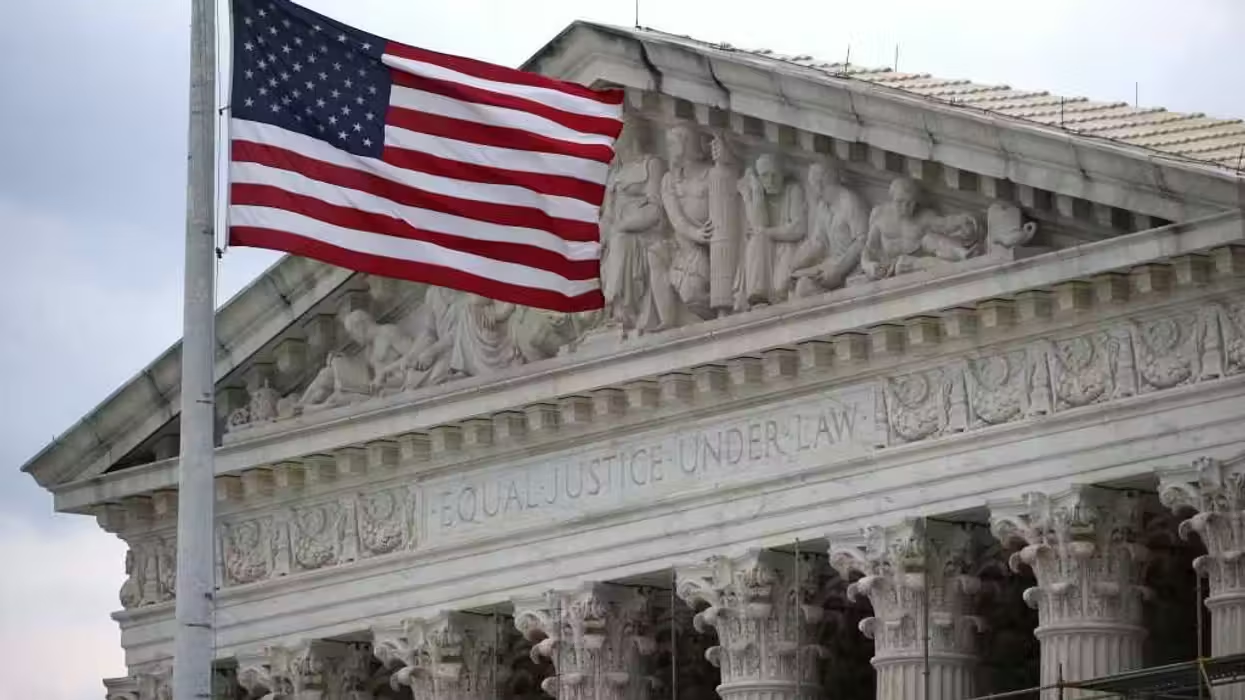 Photo by Win McNamee/Getty Images
Women who receive services from pregnancy centers report a 98% satisfaction rate. The real measure of success, however, is the women who later return to help others.
Courtney, once overwhelmed by two unexpected pregnancies, now works at the very center that supported her.
Jean Marie, who escaped human trafficking with the help of a New Hampshire pregnancy center, now runs a center in Vermont, using her experience to counsel vulnerable women.
In Northern Virginia, a maternity home helped Shawnte when she lost her job and housing. Today she works as a peer-recovery coach and credits the maternity home with giving her the strength not to abort “a child I knew I wanted, just because things got hard.”
These women — and countless others — were empowered by the pro-life safety net and now devote themselves to strengthening it for the next mother in crisis.
This is work that protects lives, stabilizes families, and strengthens communities. It deserves support, not intimidation from pro-abortion politicians. When First Choice made its case before the Supreme Court, it stood up for every American who believes mothers deserve compassion without harassment from the state.
Helping women is not controversial. It is love in action.
For once, Medicare is trying something that actually saves money

Medicare is the second-largest program in the federal budget, topping $1 trillion last year. In 2023, it accounted for 14% of federal spending — a share projected to reach 18% by 2032. After years of ballooning costs, something is finally being done to slow the growth. A new Medicare pilot program, the Wasteful and Inappropriate Service Reduction model, borrows a successful private-sector tool: prior authorization. And that’s good news.
Medicare Part B premiums now sit at $185 per month — up 28% from five years ago and a staggering 76% since 2015. Last year, 12% of the 61 million Americans enrolled in Part B spent more than a tenth of their annual income on premiums. That burden is unsustainable.
In a system as expensive and fragmented as ours, no one can afford to keep writing blank checks for low-value care.
WISeR, set to launch in Ohio, Texas, Washington, New Jersey, Arizona, and Oklahoma, will require prior approval for a short list of “low-value” services — procedures that research shows are frequently overused, costly, and sometimes harmful.
To some, the idea of Medicare reviewing certain treatments before covering them may sound like red tape. But when done correctly, prior authorization is not a barrier. It is a guardrail — one that protects patients, improves quality, and helps ensure that both tax dollars and premiums are spent appropriately.
The goal of WISeR is simple: Cut unnecessary treatments and shift resources toward more effective, evidence-based care. Critics warn about the possibility of delays or extra paperwork, and those concerns are worth monitoring. But they don’t negate prior authorization’s potential to make U.S. health care safer, more efficient, and more financially stable.
Prior authorization directly targets some of the most persistent problems in health care. Medicare spends billions each year on low-value services. A 2023 study identified just 47 such services that together cost Medicare more than $4 billion annually. Those are taxpayer dollars that could be put to better use.
The private insurance market shows the same pattern: unnecessary imaging, avoidable specialist referrals, and brand-name drugs chosen over generics all contribute to rising premiums. Prior authorization, when used properly, reins in this waste by ensuring coverage lines up with medical necessity and evidence-based best practices. Research from the University of Chicago shows that Medicare’s prior authorization rules for prescription drugs generate net savings even after administrative costs.
Consider one striking example. Medicare Part B covers wound-care products known as skin substitutes. But an Office of Inspector General report found that expenditures on these products skyrocketed over the past two years to more than $10 billion annually. Meanwhile, Medicare Advantage plans — which rely heavily on prior authorization — spent only a fraction of that amount for the same treatments.
RELATED: When a ‘too big to fail’ America meets a government too broke to bail it out
 DNY59 via iStock/Getty Images
More importantly, prior authorization helps promote evidence-based medicine. It curbs outdated clinical habits and reduces financial incentives to overtreat. Health plans consistently say that prior authorization aligns care with gold-standard clinical guidelines, particularly in areas prone to misuse.
Of course, the system must be designed responsibly. A well-functioning PA process should be transparent, fast, and grounded in strong clinical evidence. Decisions should be made in close coordination with the patient’s treating provider. The appeals process must be straightforward. And both public and private payers should be held accountable for improper denials or harmful delays.
When structured this way, prior authorization is far more efficient than the current “pay-and-chase” model, where Medicare pays first and tries to recover improper payments later.
Prior authorization already works in the private sector. It can work in Medicare.
Public and private payers have an obligation to steward the dollars they spend — whether those dollars come from taxpayers or premium-payers. In a system as expensive and fragmented as ours, no one can afford to keep writing blank checks for low-value care. When implemented wisely, prior authorization keeps coverage aligned with medical necessity, elevates the value of care, and helps deliver better outcomes at a sustainable cost.
My crooked house made me rethink what really needs fixing

Our new addition is finally finished — level floors, wide doors, and a space where my wife, Gracie, can move freely despite her severe disabilities. After years of improvising in tight quarters, we’re grateful to have a place that works for us, even if it’s not perfect.
The new part of the house went up during Trump’s second non-consecutive term; the original part went up during the second term of the only other president to do the same, Grover Cleveland. Joining the two is a bit like welding a Tesla to a horse-drawn buggy — functional, charming, and only slightly defiant of gravity.
When most of life leans, you can still make one crooked thing right.
During construction, the fridge in our tiny kitchen got bumped off the carefully placed shims and tilted just enough to drive me crazy. Admittedly, that’s not a long trip.
I ignored it for about a week but finally couldn’t stand it anymore. Leveling a refrigerator in a cabin built during the Cleveland administration isn’t simple. There are pulleys, levers, questions about physics, and — in my case — a call to the engineering department at Montana State. They were not amused. My neighbor Charles, who often “pity helps” me, wasn’t available. I can’t prove it, but I think he hung up and immediately burst into laughter.
So I did it myself.
I knew it would be a project — and once I started, it could not easily be interrupted by caregiving duties. But exasperation collided with need, and I got down on the floor (at a slant) and went to work. It went exactly as expected: mild swearing, a few tears, and then a small victory. When the bubble on the level finally drifted near the center, I declared success, remembering that old rancher’s saying: “Most things can be fixed with baling wire and bad language.”
It’s level — well, Montana level — but I’ll take it.
Much of what I’ve faced as a caregiver over 40 years can’t be fixed. But small victories, like leveling a refrigerator in a house built when bread was 3 cents and buffalo still outnumbered politicians, remind me that even when most of life leans, you can still make one crooked thing right.
Everyone has a version of that tilted refrigerator — something off-kilter you keep meaning to fix but never quite reach. It might be a strained relationship, a stack of bills, or a heart worn down by too much bad news. You can’t straighten the world, but you can steady what’s right in front of you.
When life feels unsettled, taking time to level something — even a small thing — matters more than we think. Sometimes that quiet act of setting one thing right gives us just enough footing to stand through the rest of it.
RELATED: When fathers fall, grace asks more of us
 Osobystist via iStock/Getty Images
Years ago, city officials talked about “broken-window” policing: Neglect one thing, and the whole neighborhood starts to crumble. The opposite is also true. Fix one small thing, and a bit of order comes back. Leveling even one ordinary object pushes back against the chaos.
Most caregiving must be repeated tomorrow, but every so often something stays fixed. A grab bar anchored in the right place. A ramp that finally fits the chair. The day may still be full of mess and pain, but that one thing won’t need doing again. It stands there quietly, reminding you that not everything leans. Some things still hold. And sometimes that’s enough to remind you that you still can too.
When I turn on the news, I see dysfunction I can’t do anything about. But when I fix dinner, my refrigerator no longer leans.
There’s an old Appalachian saying: “Fix what you can. The rest was never yours to mend.”
Level what you can. Let the rest lean.
Killing drug ads won’t lower prices — it will kill innovation

The United States is one of the few countries that allows prescription drugmakers to speak directly to patients. That simple fact now fuels political calls to “ban the ads.” But restricting direct-to-consumer advertising would do more than change what runs during football games. It would shrink the flow of information to patients and push our system toward the bureaucratic throttling that has turned other countries into innovation laggards.
Advertising is part of a dynamic market process. Entrepreneurs inform consumers about new products, and when profits are high, firms have every incentive to improve quality and expand access.
The pattern is clear: The more Washington intervenes, the fewer cures Americans get.
New, cheaper treatments need to be brought to consumers’ attention. Otherwise, people stay stuck with older, more expensive options, and competition falters. Banning pharmaceutical advertising would hobble innovative firms whose products are not yet known and leave those seeking medical care less informed.
Critics warn that “a growing proliferation of ads” drives demand for costly treatments, even when less expensive alternatives exist. Yet a recent study in the Journal of Public Economics finds that exposure to pharmaceutical ads increases drug utilization across the board — including cheaper generics and non-advertised medications. In short, advertising pushes people who need care to make better, more informed decisions.
A market-based system rewards risk-taking and innovation. Despite the many flaws in American health care, the United States leads the world in medical breakthroughs — from cancer immunotherapies to vaccines developed in record time. That success wasn’t created by government decree. It came from competition: firms communicating openly about their products, fighting for patients, and reinvesting earnings into the next generation of lifesaving discoveries.
Sure, some regulations are adopted with good intentions. But drug ads are already heavily regulated, and a full ban would create serious unintended consequences — including the unseen cost of innovative drugs that will never reach patients because firms won’t invest in developing treatments they are barred from promoting.
American health care is now regulated to the point of satisfying no one. Patients face rising costs. Physicians navigate a Kafkaesque maze of top-down rules. Taxpayers foot the bill for decisions made by distant bureaucracies. Measures associated with socialized medicine continue creeping into the marketplace.
Price controls in the Inflation Reduction Act are already cutting into pharmaceutical research and development. One study estimates roughly 188 fewer small-molecule treatments in the 20 years after its enactment. The pattern is clear: The more Washington intervenes, the fewer cures Americans get.
RELATED: Trump faces drugmakers that treat sick Americans like ATMs
 Photo by Andrew Harnik/Getty Images
The answer to the problems in American health care isn’t more government. It’s less. Expected profitability drives investment in biomedical research. Imposing new advertising bans or European-style price controls would mean lower-quality care, higher mortality, and the erosion of America’s leadership in medical innovation.
The United Kingdom offers a warning. Once a global leader, it drove investment offshore through overregulation and rigid price controls. Today, only 37% of new medicines are made fully available for their licensed uses in Britain. Americans spend more, but they also live longer: U.S. cancer patients outlive their European counterparts for a reason.
Discovering new drugs is hard. Every breakthrough begins with the freedom to imagine, to compete, and to communicate. Strip companies of the ability to inform patients, and you strip away the incentive to develop the next cure. Competitive markets — not centralized control — will fuel tomorrow’s medical miracles.
Settling Afghans here puts America last

I have a longtime friend — I’ll omit his name because he is somewhat politically prominent — who has been very involved in the extraction of Afghans who allegedly helped us from Afghanistan and resettlement of them in the United States. My friend already has a demanding job, but he has often worked through the night, forgoing sleep to help with this task.
I have several strong political disagreements with him, but I would never question his patriotism. He voluntarily served as a soldier in Afghanistan after overcoming great obstacles to be accepted into the military. But I would strongly question his political judgment and the judgment of anyone who thinks we should be settling Afghan refugees in America.
‘The second the US military backed out, their men folded and refused to fight for what we gave them. We don’t owe them, they owe us.’
Unfortunately, a number of our former soldiers, no matter how sincere their beliefs, seem to sympathize more with people in a foreign country whom they believed, rightly or wrongly, to be allies rather than with the interests of the only country to which they owe their allegiance.
Joe Kent, an Afghanistan combat veteran and director of the National Counterterrorism Center, argued on social media for the deportation of all of our “Afghan allies.”
“Vetting a foreigner in a war zone to determine if he will fight a common enemy is vastly different than vetting a foreigner to see if he is suitable to live in our country,” Kent wrote.
As journalist Daniel Greenfield notes, the targeted attack on two National Guardsmen by an Afghan national in Washington, D.C., the day before Thanksgiving was not a one-off. It’s part of an extensive series of assaults by Afghans whom we have foolishly allowed to resettle in the United States.
Unbridgeable inequalities
Having lived briefly in a third-world country and having traveled for many years in various countries of that description, I have quickly learned to be wary of “friendships.” It is not that people in these countries are inherently bad or incapable of genuine friendship in principle. It is that the gap between you (a well-off American) and them (a third-world citizen who, even if relatively affluent, is often at a huge disadvantage versus an American) is astronomical.
And that gap is not just financial and legal, but also based on traditions and customs. Relationships that may feel like genuine friendship for a time usually come with future requests or pleas for assistance. Again, I don’t necessarily blame these people — I might do the same in their shoes — and of course genuine friendships in such situations are possible, but they are far rarer than idealists might wish them to be.
What applies in basically peaceful third-world countries applies a thousandfold in an impoverished, war-torn, and primitive country like Afghanistan. It is monstrously arrogant to think the American political class understands deeply the inner workings of these countries and the motivations of the people there, given that we spent almost $1 trillion to occupy Afghanistan, only to see all of our efforts collapse within a week after we removed our military as a threat of force.
Wade Miller, the executive director of Citizens for Renewing America and a U.S. Marine combat veteran, responded to the claim that resettling Afghans was the moral thing to do since they “fought alongside our own” soldiers, rightly calling it a “BS metric.” As he noted, “1. Many played both sides. 2. Many only did it to make money. 3. Many were plants. 4. Many had long-standing tribal grudges against the Taliban.”
And none of them necessarily has a long-term loyalty to America, which is the first step to assess before even beginning to consider a claim of residency.
All of this would be obvious to anyone who does not let suicidal empathy overwhelm good sense. But unfortunately, we have lost that common sense, even among many of our supposedly hardened fighting forces.
‘We don’t owe them’
Miller punctures the lie that we owe these Afghans for “doing America a favor,” pointing out that we did them a favor by expending American lives and treasure to help them govern themselves without the Taliban. But “the second the U.S. military backed out, their men folded and refused to fight for what we gave them. We don’t owe them, they owe us.”
This is a harsh assessment, but in the aggregate, it is not unfair.
Or consider what Mark Lucas, an Afghanistan veteran and founder of the Article III Project, has written: “Afghans were untrustworthy allies who sold their children to pedophiles, ritually raped little boys, and beat their women.” He notes that without male soldiers guarding them, countless local Afghans made clear that they would have raped the women who were attached to their detachment.
RELATED: Trump makes America dangerous again — to our enemies
 Jim Watson/Getty Images
Lucas points out that even asking simple questions of potential Afghan asylum-seekers, such as whether they support putting apostates to death, child marriage, Sharia for non-Muslims, defense of suicide bombings, polygamy, and honor killings, would quickly disqualify them. The vast majority of Afghans, he says, support one or more of these views — none of which are compatible with the American way of life.
One of the few Afghan refugees who resettled in my own state of Montana promptly raped a Montanan shortly after his arrival. Unsurprisingly, the crime and its implications were shamefully underreported by local media.
Toward a more sober policy
Even assuming we have an obligation to those we believed helped us in Afghanistan, it would mean we were obligated to get them to safety — not get them to America. If we had made it clear at the outset that relocating to America was not on offer, we would have see a drastic reduction in the number of “refugees.” We can and should resettle them in other countries. Making arrangements to do that is a worthy use of American soft power.
The notion that resettling Afghans in America is a moral duty reflects Joe Biden’s poor political leadership. His administration and previous ones before it had become arrogant about their ability to control events and remake complex societies and peoples far different from our own. In reality, their policies promoted cultural arrogance under the guise of friendship. They abandoned our own in favor of those from distant cultures and lands.
Let us hope that President Trump’s promise to refuse all new Afghan visas and to remove postwar arrivals and resettle them elsewhere is the start of a more sober, realistic, and serious refugee policy that will put the interests of America and its citizens first.
Editor’s note: A version of this article appeared originally at the American Mind.
Washington’s new favorite lie: ‘Most migrants are safe’

If anyone from a backward and unstable country could be vetted for anti-American hostility, it would have been someone like Rahmanullah Lakanwal, the Afghan national who allegedly shot two National Guardsmen in Washington, D.C., the day before Thanksgiving. He had been vetted by the CIA, worked with our military in Afghanistan, and was later approved for asylum alongside his wife and five children.
And still, he turned his gun on the very country that took him in. How many more reminders do we need before we shut off the spigot?
Tackling America’s economic challenges will be tricky. But an immigration shutoff is easy. Trump can — with the stroke of a pen — halt all entries that threaten national security.
In response to the attack, President Trump vowed to “permanently pause migration from all third world countries.” Many Americans hoped this meant fulfilling the pledge he made nearly a decade ago: “A total and complete shutdown of Muslims entering the United States until our country’s representatives can figure out what the hell is going on.”
On Thanksgiving Day, U.S. Citizenship and Immigration Services Director Joseph Edlow announced a “full-scale, rigorous reexamination of every green card” holder from “every country of concern.” When pressed, Edlow pointed to the 19 countries listed in Trump’s June 4 proclamation, “Restricting the Entry of Foreign Nationals to Protect the United States from Foreign Terrorists and Other National Security and Public Safety Threats.”
That June order established two tiers of restrictions.
Full restriction: Afghanistan, Burma, Chad, Republic of the Congo, Equatorial Guinea, Eritrea, Haiti, Iran, Libya, Somalia, Sudan, Yemen.
Partial restriction: Burundi, Cuba, Laos, Sierra Leone, Togo, Turkmenistan, Venezuela.
This week, the White House announced its intention to pause all immigration from all 19 countries and freeze naturalization applications from nationals already here.
It’s a start. But it doesn’t address the larger reality: Even a total shutdown of these 19 countries barely dents the scale of Islamic-world migration into the United States.
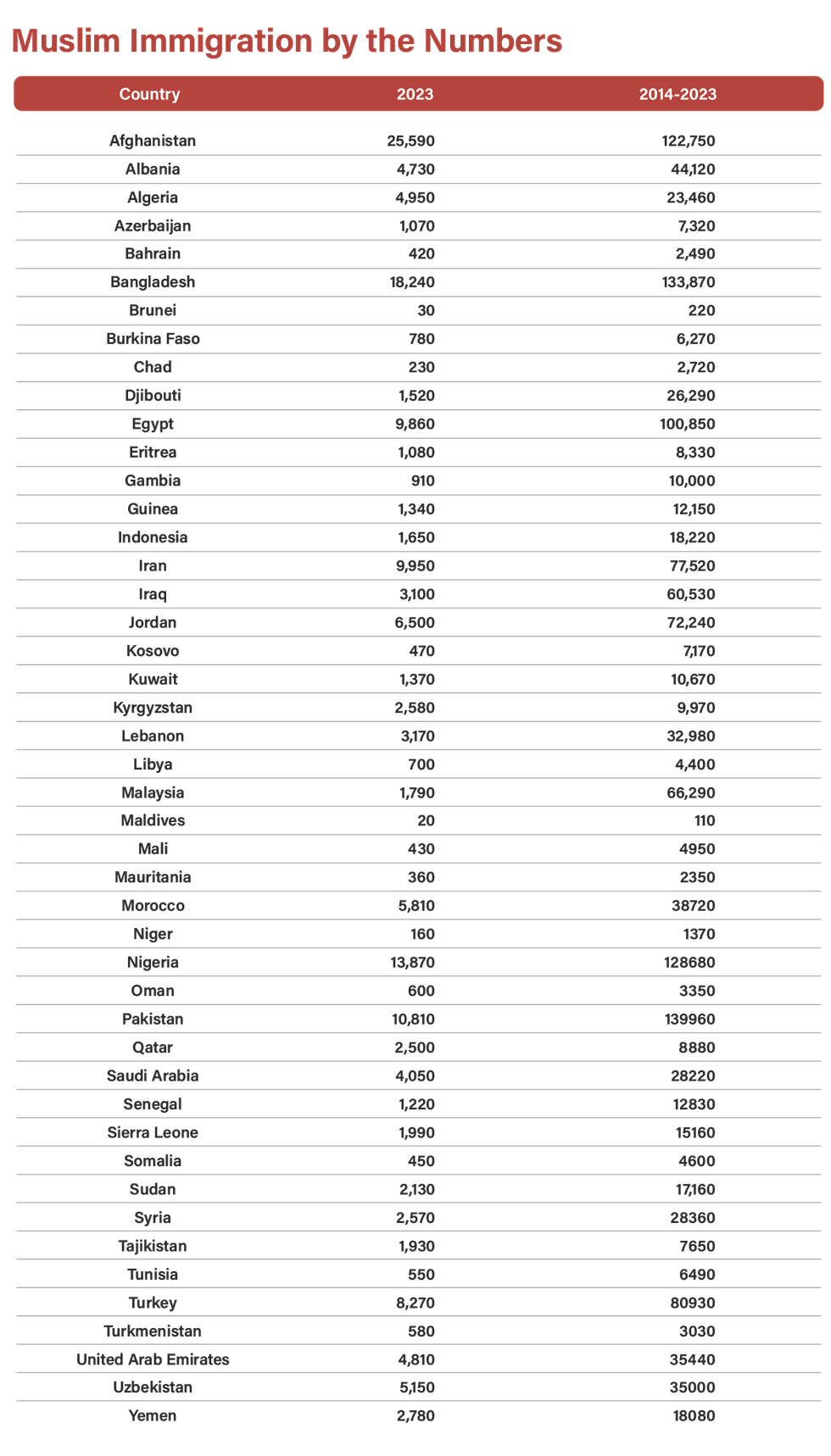
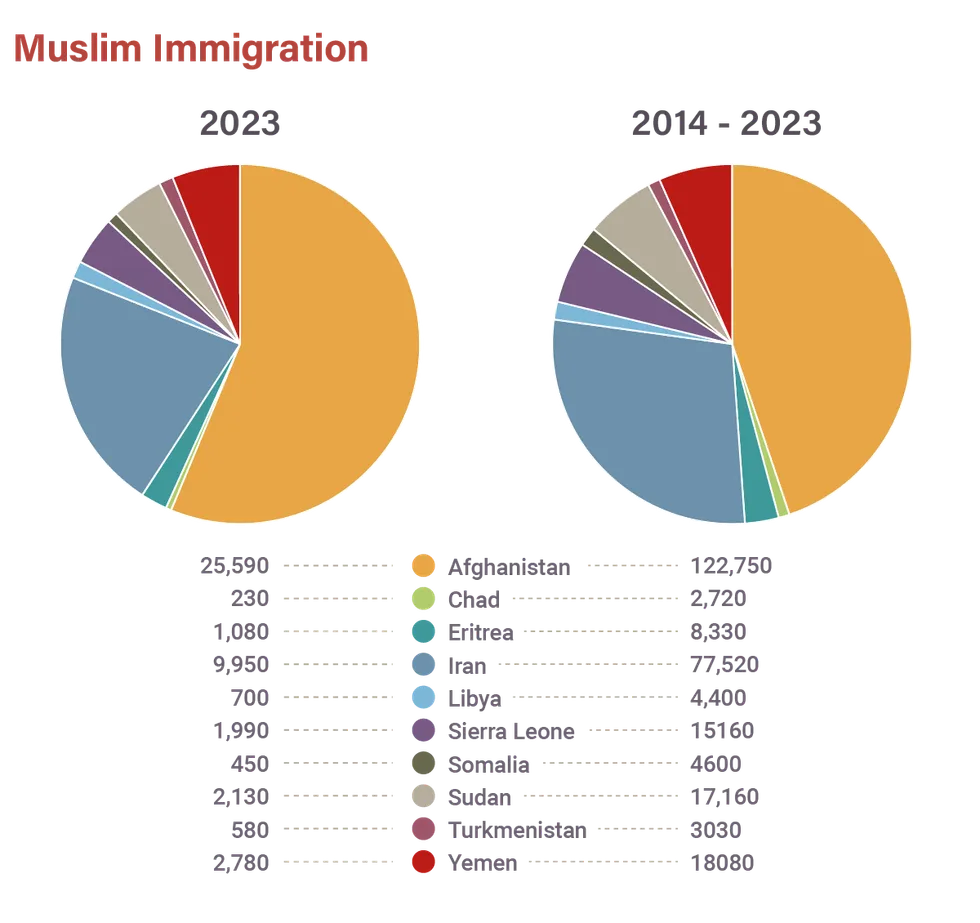
By my calculations, these countries account for only 27% of Muslim-origin immigration in 2023 — and just 18% of our intake from the Islamic world over the past decade.
Ten of the 19 targeted countries are majority-Muslim. But there are 39 other majority-Muslim countries — most overwhelmingly Muslim — from which we admit well over 100,000 green-card recipients each year.
Here is the updated breakdown of immigration from all majority-Muslim countries in 2023 and over the prior 10 years:
 Blaze Media
This is a numbers game. You simply cannot import roughly 175,000 Muslim migrants every year — not counting tens of thousands more on student and temporary visas — without replicating the social unraveling we have seen in Europe.
Trump’s expanded ban would block about 47,000 of these arrivals annually. But it leaves massive sending countries — Bangladesh, Egypt, Turkey, Lebanon, Syria, Saudi Arabia, Jordan, Iraq, Uzbekistan — effectively untouched.
 Blaze Media
The problem with limiting the moratorium to these 10 Islamic countries (plus nine other hostile or unstable states) isn’t just numerical. It’s philosophical. The order implies that we are only concerned with countries that have poor diplomatic relations or inadequate data-sharing with the United States.
But the challenge of Islamic migration has never been solely about vetting. Most individuals who embrace Sharia supremacism, support suicide attacks, or reject Western norms are not sworn members of al-Qaeda or Hezbollah. The issue is ideological — a form of unreformed Islam that never passed through the Enlightenment and remains fundamentally incompatible with liberal Western society.
For decades, small-scale migration masked this reality. But we have admitted roughly 3 million Muslims since 9/11. They cluster, build Qatari-funded or Muslim Brotherhood-affiliated mosques, and reproduce the same ideological ecosystem from which they emigrated. High-volume flows reinforce the problem exponentially.
And contrary to the foreign-policy establishment’s assumptions, hostility does not only come from “enemy” states. In fact, migrants from “friendly” governments often pose greater risks. Regimes such as Egypt and Jordan suppress their own Islamist movements. Uzbekistan bans full beards. These governments contain radicalism at home — and we import the very people they fear.
We’ve seen the consequences repeatedly. A sampling:
- Akayed Ullah, who arrived from Bangladesh in 2011, detonated a pipe bomb in the Port Authority Bus Terminal, declaring support for ISIS. Bangladesh now sends more than 18,000 immigrants annually.
- Sayfullo Saipov, who came from Uzbekistan in 2010 on a diversity visa, murdered eight people in a truck attack in Manhattan while shouting “Allahu Akbar.”
- Dilkhayot Kasimov, Abdurasul Juraboev, Abror Habibov, all Uzbeks, conspired to support ISIS, discussed attacking President Obama, and scouted U.S. military targets. We continue admitting over 5,000 Uzbeks per year through the Diversity Visa Lottery — a program Trump should end immediately.
- Muhammad Khair Alabid, a student from Egypt, plotted a Fourth of July vehicle-bomb attack in Cleveland.
- Mohamed Sabry Soliman, also from Egypt, firebombed a pro-Israel rally in Boulder in 2025, killing one and injuring 12. He and his family were admitted by the Biden administration and overstayed. We have issued more than 100,000 green cards to Egyptian nationals in the past decade.
- Muhammad El-Sayed, admitted from Jordan on a diversity visa, built an ISIS-linked terror cell in Minneapolis, scouting military bases and Jewish centers.
- Abdullah Muhammad Zain-ul-Abideen, a student visa-holder from Jordan, provided material support in the Garland, Texas, terrorist attack on the “Draw Muhammad” event.
 Photo by Cindy Ord/Getty Images for BAFTA
The most glaring case of false security is Mohammed Saeed Alshamrani, a Saudi military trainee brought here on an A-2 visa. In 2019, he murdered three American service members at Naval Air Station Pensacola. He was here because our government trusted Saudi vetting.
This is the pattern: Working with a regime is not the same as trusting its people. In many cases, these governments fear their own populations. Yet we continue importing those populations at scale.
For example: The United States and Israel prop up the Hashemite monarchy in Jordan precisely because its people are more radical than their rulers. Yet we have brought in over 72,000 Jordanians in the past decade. If those populations are too dangerous for their own government, why do we assume they are safe for ours?
When it comes to transformational immigration policy, there is no such thing as “lukewarm hell.” Trump should impose a full moratorium on all Islamic-majority countries and abolish the Diversity Visa Lottery entirely.
Tackling America’s economic challenges ahead of the midterms will be tricky. But an immigration shutoff is easy. Under Section 212(f) of the Immigration and Nationality Act, Trump can — with the stroke of a pen — halt all entries that threaten national security.
He has already done it for 19 countries. He has no reason not to finish the job.





