

Category: Opinion & analysis
‘Chatbot Jesus’ is a digital fake — and churches are falling for it
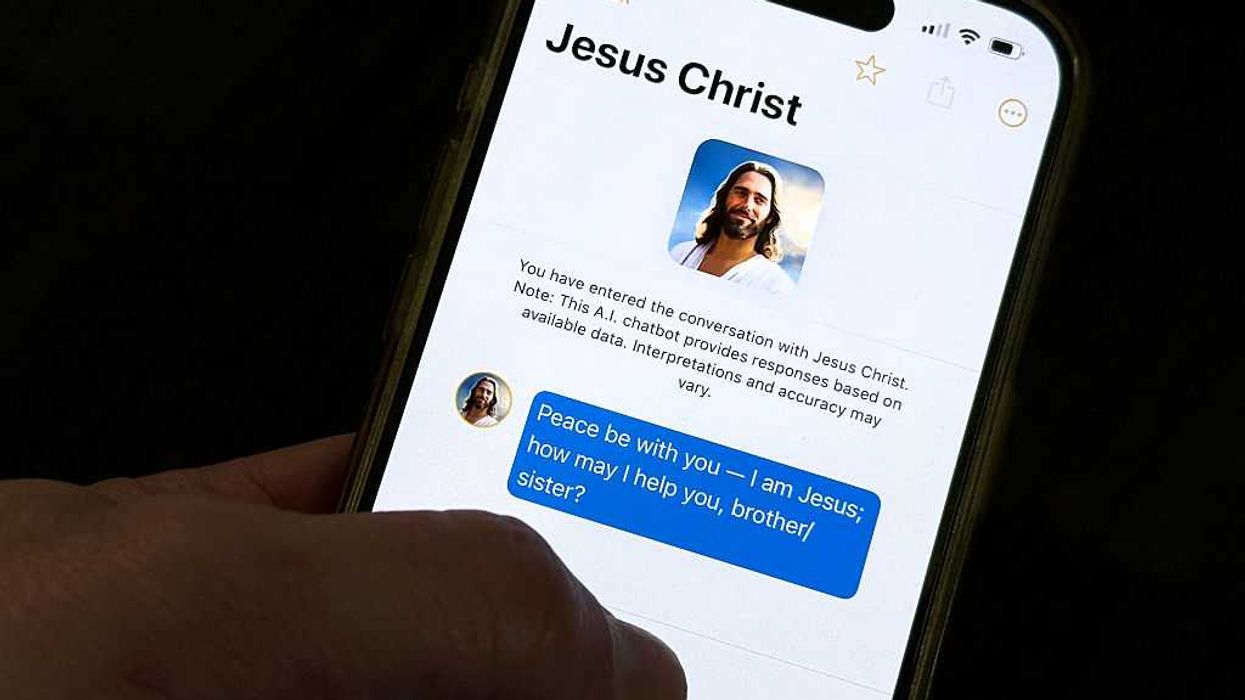
Artificial intelligence now offers “Chatbot Jesus,” personalized prayers, AI-generated sermons, and even virtual pastors charging monthly fees. Some see these tools as a lifeline for shrinking congregations. Others claim they offer new ways to evangelize.
The church must speak plainly: We are not called to relevance. We are called to righteousness. Scripture commands believers to “test all things; hold fast what is good.”
People are not abandoning faith because the church lacks modern technology. They are leaving because they are starving for truth in an age of deception.
Technology itself is neither holy nor wicked. The printing press, radio, livestreaming, and Bible apps have all served ministry. AI that organizes calendars, translates languages, or answers simple questions is just another tool.
Crossing a biblical line
Trouble begins when technology imitates divinity. An app that invites people to “talk with Jesus” steps into territory Scripture reserves for the living God alone. Jesus said, “My sheep hear My voice” (John 10:27). Only the Lord speaks with the authority of Matthew 24:35: “Heaven and earth will pass away, but My words will by no means pass away.”
No chatbot can make that claim.
The danger becomes obvious when apps offer simulated “conversations” with Judas or Satan. God forbids consulting spirits, mediums, or conjured voices (Leviticus 19:31; Deuteronomy 18:10-12). Why would the church encourage digital re-creations of what Scripture calls an abomination?
Convenience or relevance cannot override explicit biblical commands.
You can’t outsource the Holy Spirit
Some pastors now admit they use AI to help write sermons. Others market “avatar” versions of themselves. But ministry has never centered on polished prose. It has always centered on God’s power — His breath, His Spirit, His Word.
Paul wrote, “My message and my preaching were not with wise and persuasive words, but with a demonstration of the Spirit’s power” (1 Corinthians 2:4).
You cannot automate the power of God. You cannot outsource the voice of the Holy Spirit. You cannot download anointing.
A sermon is not literary content to be refined by software. It must be birthed in prayer, wrestled through in Scripture, and delivered in obedience. As Jesus said, “Apart from Me you can do nothing” (John 15:5). That includes preaching.
Tech won’t save us
Axios reported that up to 15,000 churches may close this year and that 29% of Americans now claim no religion. That trend calls for actual spiritual renewal, not AI simulations of Jesus.
People are not abandoning faith because the church lacks modern technology. They are leaving because they are starving for truth in an age of deception. The early church grew because believers “continued steadfastly in the apostles’ doctrine and fellowship … and fear came upon every soul” (Acts 2:42-43). They witnessed repentance, signs, wonders, and transformation — none of which machines can produce.
True revival begins where the early church began: holiness, unity, prayer, obedience, and the power of the Holy Spirit.
A distortion of Christ
False voices proclaiming truth are not new. The only novelty is that they are now automated. The central danger of “AI spirituality” is doctrinal corruption. What sources shape these chatbots? What ideology trains them? If systems learn from shallow teaching or progressive theology divorced from Scripture, they will preach a distorted Christ.
When AI “hallucinates” — and all current systems do — it can hand users outright lies.
Jesus warned, “Beware of false prophets … you will know them by their fruits” (Matthew 7:15-16). Paul warned that if anyone preaches “any other gospel … let him be accursed” (Galatians 1:8). From Genesis onward, the devil has counterfeited God’s voice. AI can and will preach an “other gospel” if it draws from anything other than Scripture.
RELATED: God-tier AI? Why there’s no easy exit from the human condition
 gremlin via iStock/Getty Images
Believers must remain discerning. “Do not be deceived” (1 Corinthians 15:33). “Beware lest anyone cheat you through philosophy and empty deceit” (Colossians 2:8). Those who build their faith on machine-generated counsel risk building a house on sand rather than the Rock (Matthew 7:24-27).
A servant, not a shepherd
Tools can organize schedules and streamline communication. They can assist brainstorming. But preaching, prayer, prophecy, discipleship, deliverance, and counsel belong to the life of the Spirit — not the cold logic of machines.
Technology must remain a servant. It must never become a shepherd. Only the good shepherd, Jesus Christ, leads His people.
Jesus said, “I am the door of the sheep,” “I am the good shepherd,” and “I lay down My life for the sheep” (John 10). No AI pastor and no “Chatbot Jesus” can claim any of that.
Revival will not come from faster processors or stronger large language models. It will come when God’s people “humble themselves,” pray, seek His face, and turn from their wicked ways (2 Chronicles 7:14).
The world does not need a digital imitation of Jesus. It needs the real Jesus — the one who, as Hebrews 13:8 tells us, “is the same yesterday, today, and forever.”
It’s not ‘racist’ to notice Somali fraud

Last week, my colleague Ryan Thorpe and I broke a story about widespread fraud committed by Somalis in Minnesota. Members of the state’s Somali community allegedly participated in complex schemes related to autism services, food programs, and housing, which prosecutors estimate have stolen billions of taxpayer dollars. Even worse, some of the cash has ended up in the hands of Al-Shabaab, a terrorist organization in Somalia.
The story quickly reached the White House. Within days, President Trump announced that he was revoking Temporary Protected Status for all Somali migrants in Minnesota.
Progressives have suggested that our reporting and the subsequent policy change were “racist.” While many of those indicted in these schemes are Somali, these critics argue, the federal government should not hold Minnesota’s Somali community corporately responsible for the actions of individuals.
Little Mogadishu in Minneapolis has a real problem, and it is about time that our government began facing it.
This criticism is superficially appealing, but it isn’t persuasive on closer inspection.
First, a description of the facts should not be measured as “racist or not racist,” but rather as “true or not true.” And in this case, the truth is that numerous members of a relatively small community participated in a scheme that stole billions in taxpayer funds. This is a legitimate consideration for American immigration policy, which is organized around nation of origin and, for more than 30 years, has favorably treated Somalis relative to other groups. It is more than fair to ask whether that policy has served the national interest. The fraud story suggests that the answer is “no.”
Second, the fact that Somalis are black is incidental. If Norwegian immigrants were perpetrating fraud at the same alleged scale and had the same employment and income statistics as Somalis, it would be perfectly reasonable to make the same criticism and enact the same policy response. It would not be “racist” against Norwegians to do so.
Further, Somalis have enormously high unemployment rates, and federal law enforcement has long considered Minneapolis’ Little Mogadishu neighborhood a hot spot for terrorism recruitment. We should condemn that behavior without regard to skin color.
The underlying question — which, until now, Americans have been loath to address directly — is that of different behaviors and outcomes between different groups. Americans tend to avoid this question, rely on euphemisms, and let these distinctions remain implied rather than spoken aloud. Yet it seems increasingly untenable to maintain this Anglo-American courtesy when the left has spent decades insisting that we conceptualize our national life in terms of group identity.
The reality is that different groups have different cultural characteristics. The national culture of Somalia is different from the national culture of Norway. Somalis and Norwegians therefore tend to think differently, behave differently, and organize themselves differently, which leads to different group outcomes. Norwegians in Minnesota behave similarly to Norwegians in Norway; Somalis in Minnesota behave similarly to Somalis in Somalia. Many cultural patterns from Somalia — particularly clan networks, informal economies, and distrust of state institutions — travel with the diaspora and have shown up in Minnesota as well. In the absence of strong assimilation pressures, the fraud networks aren’t so surprising; they reflect the extension of Somali institutional norms into a new environment with weak enforcement and poorly designed incentives.
The beauty of America is that we had a system that thoughtfully balanced individual and group considerations. We recognized that all men, whatever their background, have a natural right to life, liberty, property, and equal treatment under the law. We also recognized that group averages can be a basis for judgment — especially in immigration, where they can help determine which potential immigrant groups are most suitable and advantageous for America.
RELATED: Chip Roy’s immigration blitz hits the lawless left and the squish right
 Photo by Andrew Harnik/Getty Images
These principles are in tension but not in contradiction. As a sociological matter, a policy of equal rights for all individuals will result in unequal outcomes among groups. This is not a sign of injustice per se. It is an inevitability. No two groups are the same, and therefore, no two groups will have the same outcomes in a system of individual liberty and equality.
The firestorm around the Somali fraud story was so intense precisely because it forced this question into the spotlight. For decades, America has given Somali immigrants special privileges through TPS. We have expected Somalis to play by the rules, contribute to the country, and assimilate into the culture. Some individuals have certainly done so, but as the fraud story suggests, many others have not. A rational government would amend its policies accordingly.
We can see the same process playing out in other parts of the world. In the United Kingdom, mass immigration from incompatible cultures is creating a civilizational crisis. Rather than replicate the policies of our sister country, we should accept reality and adopt a more thoughtful policy, which recognizes cultural norms as a reasonable measure of capacity to assimilate and to contribute.
The president should stand firm. Little Mogadishu in Minneapolis has a real problem, and it is about time that our government began facing it.
Editor’s note: This article appeared originally on Substack.
Joe Rogan gets the aliens wrong — and the danger right

Joe Rogan wants the truth — the truth that’s “out there,” the one Mulder and Scully chased for 11 seasons and two movies. According to filmmaker Dan Farah, who visited Rogan’s podcast last week to promote his documentary “The Age of Disclosure,” that moment has arrived. Farah claims to have firsthand testimony from government officials, with “years of receipts,” showing the federal government spent more than $1 trillion trying to reverse-engineer alien technology.
A trillion dollars! That’s enough to fund several more DEI directors at Harvard.
Demonic influence is not a science-fiction plot. It’s a timely warning: Reconcile with God through Christ, the true and only source of wisdom — not ‘from out there,’ but from above.
Farah insists this program involved “thousands of ordinary people,” the kind who sit next to you at your kid’s baseball game. Apparently half of Little League moonlights in Area 51 while parents compare batting averages. You’re just not in the inner circle.
The surprising part? Rogan and Farah talk as if the existence of nonhuman intelligences would be a revelation. They’re eager for someone — anyone — to tell them we’re not alone.
Christians knew
But Christians have never needed the Pentagon’s confirmation. We have always known nonhuman intelligences exist.
Start with God: infinite, eternal, unchangeable mind. All intelligence comes from Him, because unintelligent matter cannot, after any number of billions of years, spontaneously generate intelligent minds. Zero intelligence multiplied forever remains zero.
Then consider the finite nonhuman intelligences scripture describes: angels and demons. No need for wormholes, gray abductions, or Jack Parsons and L. Ron Hubbard attempting to open a Crowleyan portal in Pasadena during the 1940s.
“Close encounters” sound exactly like old accounts of demonic encounters: gray, genderless beings with dark, soulless eyes examining humans in sterile rooms. And for creatures supposedly traveling across eons, their décor could use work. Not a single family photo from last summer’s reunion on Alpha Centauri.
Science breaks the UFO narrative
Yet Rogan and Farah ask us to imagine intelligent beings evolving hundreds of light-years away, building starships, crossing the void, and arriving here to perform intergalactic medical internships while mutilating cattle on the weekends. The story collapses under basic science.
First, the materialist timeline breaks the theory. On the materialist view, the universe hasn’t existed long enough for an advanced civilization to evolve millions of years ahead of us. Life, according to that timeline, barely had enough time to form at all. The standard narrative demands amino acids to mix into proteins struck by lightning, producing a single cell that survives and evolves — a process requiring vast time and even more credulity.
After mocking intelligent design, Richard Dawkins famously speculated that life on earth might have been seeded by aliens from a more advanced civilization. That explanation is still intelligent design, just with extra steps. Where did those aliens come from? An even older alien civilization, of course.
Second, interstellar travel requires absurd time spans. From the nearest star system, the trip would take tens of thousands of years. Wormholes won’t help. They can move particles, not starships. Even if the grays enjoy long lives, this demands millennia of travel with no sign of civilizational collapse, boredom, or mutiny.
Third, space debris makes large spacecraft nearly impossible. Only needle-thin craft could survive without being obliterated by debris. At near-light speeds, even tiny collisions would be catastrophic. Current dreams of laser-sail propulsion can only accelerate gram-scale probes to a fraction of light speed. They cannot carry bodies — especially not the grays of rural Oregon fame.
Once you eliminate the impossible under materialism, what remains?
Start by clearing out hoaxes, attention-seeking stunts, lies, and simple misidentifications. During an ordinary Southwest flight, I once thought I saw the classic cigar-shaped alien vessel Erich von Däniken loves to describe. A slight bank changed the angle of light. It was an American Airlines jet.
What remains looks far more like demonic activity than extraterrestrial biology.
Beware the occult instinct
The strangest feature of UFO mythology is the insistence that these beings are benevolent and wiser than we are. Hence Farah’s claim that the U.S. government spent trillions trying to reverse-engineer their technology. Yet if these creatures were truly advanced and benevolent, why make us run a trillion-dollar scavenger hunt? Why not offer the owner’s manual? Strange manners for enlightened space travelers.
This is where the old religious instinct surfaces. The script about “inter-dimensional watchers” helping humanity tracks perfectly with occult traditions. Talk about portals for nonhuman intelligences is simply updated language for communicating with demons.
RELATED: Pentagon psyop exposed: Military reportedly cooked up tales of alien technology in weapons cover-up
 Jacob Wackerhausen via iStock/Getty Images
Humans have chased that temptation since the beginning. Scripture alone forbids contacting spirits. Every other religion, philosophy, and esoteric school has sought “nonhuman intelligences” for hidden wisdom. The Bible warns this practice is idolatrous and dangerous because these spirits are malevolent, rebellious, and deceptive.
Eden sets the pattern: The serpent cast doubt on God’s word and promised greater wisdom. Humanity has listened to similar offers ever since.
Modern UFO mythology blends effortlessly with New Age fantasies about “ascended masters” and “star beings.” They promise secret knowledge, cosmic clubs, and spiritual advancement — with a credit card bonus of 50,000 light-year miles after your first payment.
Should we be surprised that governments attempt to communicate with “nonhuman intelligences”? Ancient Babylon, Egypt, and Canaan tried the same. The New Testament describes demoniacs opposing the gospel. And modern reports often note that alien encounters stop when the name of Christ is invoked. Demons flee; extraterrestrials supposedly mastering physics do not.
Angels obey God’s commands. They don’t stage UFO conferences or probe farmers after midnight.
The real disclosure we need
Joe Rogan has shown increased interest in Christianity in recent months. Yet he also loves to describe DMT trips in which he meets “nonhuman intelligences” promising hidden wisdom. He wonders if government officials meet the same beings. His soul sits at the center of a very old conflict.
Demonic influence is not a science-fiction plot. It’s a timely warning: Reconcile with God through Christ, the true and only source of wisdom — not “from out there,” but from above. God reveals His way plainly. No secrets required.
Judges break the law to stop Trump from enforcing it
Nearly 30 years ago, Congress recognized that the country could not litigate its way out of an immigration crisis.
As part of the Illegal Immigration Reform and Immigrant Responsibility Act, bipartisan majorities created expedited removal for anyone who failed to prove two years of physical presence in the United States. Anticipating a cottage industry of defense attorneys forcing the government to prove duration of unlawful stay, Congress also stripped federal courts of jurisdiction to review expedited removal orders.
At some point, the executive must defend not only its own authority but Congress’ authority to restrain the courts.
Three decades passed with little enforcement. Now, after that long dormancy, federal judges have begun reviewing cases they have no statutory authority to hear and are attempting to block President Trump from using expedited removal nationwide.
Over the line
On November 22, the U.S. Court of Appeals for the D.C. Circuit refused the Justice Department’s request for a stay in Make the Road New York v. Noem. The case challenges Trump’s policy expanding expedited removal to illegal aliens apprehended anywhere in the country, provided they cannot prove two years of continuous presence. Administrations since the 1990s ignored the statute and limited expedited removal to aliens caught at or near the border.
A district judge, despite clear statutory limits, reviewed the case and issued an injunction against most uses of expedited removal. That move set the stage for this week’s order from the D.C. Circuit — another step in a long pattern of courts seizing authority Congress explicitly withheld.
A watershed moment
The Supreme Court recently upheld the administration’s use of the Alien Enemies Act to quickly remove alien gang members. That ruling helped, but it cannot resolve the broader problem: Most illegal entrants do not fall into the “enemy combatant” category. If every non-gang-member can exhaust layer after layer of due process after invading our country, immigration enforcement collapses under its own weight.
But the central issue in this dispute is not due process at all. The decisive point is that IRAIRA explicitly authorizes expedited removal anywhere in the country and explicitly bars the federal courts from issuing “declaratory, injunctive, or other equitable relief” in any action challenging an expedited removal order.
The lone exception applies to aliens who can prove, by a preponderance of the evidence, that they possess a lawful right to remain — such as a granted asylum application. Even then, Congress set a firm 60-day window to bring such a claim. The plaintiffs in this case missed that deadline.
This challenge does not implicate the validity of an executive action. It represents a double violation of statute: courts ignoring the law that authorizes expedited removal and ignoring the law that strips them of jurisdiction to review it. Congress anticipated this exact scenario and barred it.
What Congress must do
Congress holds plenary authority over immigration and total authority over the structure and jurisdiction of federal courts. Only adjudication of a specific case lies beyond congressional reach. As Justice Clarence Thomas wrote in Patchak v. Zinke, “When Congress strips federal courts of jurisdiction, it exercises a valid legislative power no less than when it lays taxes, coins money, declares war, or invokes any other power that the Constitution grants it.”
If judges can decide every political question, define the scope of their own power, override Congress’ limits, and bind the executive even when Congress lawfully precludes them from hearing a case, the separation of powers collapses. At some point, the executive must defend not only its own authority but Congress’ authority to restrain the courts.
RELATED: The imperial judiciary strikes back
 Photo by ClassicStock/Getty Images
Just say ‘no’
Many of us have called for broader statutes stripping courts of jurisdiction over deportation. But that effort means nothing if judges can simply declare those statutes unconstitutional. Judicial supremacism has no end when the executive enforces judicial usurpation against itself.
That dynamic played out again last week. A federal judge ruled that ICE may not arrest illegal aliens solely for being in the country unlawfully unless agents obtain a warrant or prove a specific flight risk — an order that contradicts decades of law. In another case, Judge Sunshine Suzanne Sykes in California certified a class granting relief to migrants who “have entered or will enter the United States without inspection” as well as those not initially detained after crossing the border.
A government that treats judicial decrees as binding even when Congress denies jurisdiction invites a permanent veto from judges over immigration enforcement. It won’t stop until the president simply says no.
A nation without trust is a nation on borrowed time

Something drastic is happening in American life. Headlines that should leave us stunned barely register anymore. Stories that once would have united the country instead dissolve into silence or shrugs.
It is not apathy exactly. It is something deeper — a growing belief that the people in charge either cannot or will not fix what is broken.
When people feel ignored or betrayed, they will align with anyone who appears willing to fight on their behalf.
I call this response the Bubba effect. It describes what happens when institutions lose so much public trust that “Bubba,” the average American minding his own business, finally throws his hands up and says, “Fine. I will handle it myself.” Not because he wants to, but because the system that was supposed to protect him now feels indifferent, corrupt, or openly hostile.
The Bubba effect is not a political movement. It is a survival instinct.
What triggers the Bubba effect
We are watching the triggers unfold in real time. When members of Congress publicly encourage active duty troops to disregard orders from the commander in chief, that is not a political squabble. When a federal judge quietly rewrites the rules so one branch of government can secretly surveil another, that is not normal. That is how republics fall. Yet these stories glided across the news cycle without urgency, without consequence, without explanation.
When the American people see the leadership class shrug, they conclude — correctly — that no one is steering the ship.
This is how the Bubba effect spreads. It is not just individuals resisting authority. It is sheriffs refusing to enforce new policies, school boards ignoring state mandates, entire communities saying, “We do not believe you anymore.” It becomes institutional, cultural, national.
A country cracking from the inside
This effect can be seen in Dearborn, Michigan. In the rise of fringe voices like Nick Fuentes. In the Epstein scandal, where powerful people could not seem to locate a single accountable adult. These stories are different in content but identical in message: The system protects itself, not you.
When people feel ignored or betrayed, they will align with anyone who appears willing to fight on their behalf. That does not mean they suddenly agree with everything that person says. It means they feel abandoned by the institutions that were supposed to be trustworthy.
The Bubba effect is what fills that vacuum.
The dangers of a faithless system
A republic cannot survive without credibility. Congress cannot oversee intelligence agencies if it refuses to discipline its own members. The military cannot remain apolitical if its chain of command becomes optional. The judiciary cannot defend the Constitution while inventing loopholes that erase the separation of powers.
History shows that once a nation militarizes politics, normalizes constitutional shortcuts, or allows government agencies to operate without scrutiny, it does not return to equilibrium peacefully. Something will give.
The question is what — and when.
The responsibility now belongs to us
In a healthy country, this is where the media steps in. This is where universities, pastors, journalists, and cultural leaders pause the outrage machine and explain what is at stake. But today, too many see themselves not as guardians of the republic, but of ideology. Their first loyalty is to narrative, not truth.
The founders never trusted the press more than the public. They trusted citizens who understood their rights, lived their responsibilities, and demanded accountability. That is the antidote to the Bubba effect — not rage, but citizenship.
How to respond without breaking ourselves
Do not riot. Do not withdraw. Do not cheer on destruction just because you dislike the target. That is how nations lose themselves. Instead, demand transparency. Call your representatives. Insist on consequences. Refuse to normalize constitutional violations simply because “everyone does it.” If you expect nothing, you will get nothing.
Do not hand your voice to the loudest warrior simply because he is swinging a bat at the establishment. You do not beat corruption by joining a different version of it. You beat it by modeling the country you want to preserve: principled, accountable, rooted in truth.
RELATED: Blue cities reject law, reject order — and reject America
 Photo by Karla Ann Cote/NurPhoto via Getty Images
Every republic reaches a moment when historians will later say, “That was the warning.” We are living in ours. But warnings are gifts if they are recognized. Institutions bend. People fail. The Constitution can recover — if enough Americans still know and cherish it.
It does not take a majority. Twenty percent of the country — awake, educated, and courageous — can reset the system. It has happened before. It can happen again.
Wake up. Stand up. Demand integrity — from leaders, from institutions, and from yourself. Because the Bubba effect will not end until Americans reclaim the duty that has always belonged to them: preserving the republic for the next generation.
Want more from Glenn Beck? Get Glenn’s FREE email newsletter with his latest insights, top stories, show prep, and more delivered to your inbox.
‘Conspiracy theory’ is just media code for ‘we hope this never comes out’

Here are the basic rules.
First: If the corporate left-wing press doesn’t like a claim, it invariably becomes a “right-wing conspiracy theory,” usually with the tag “without evidence.” The evidence may exist. It may even sit in plain sight — but the press decides what counts.
The ruling class wants your trust back. It hasn’t done the first thing to deserve it.
Second: Some claims get taken seriously no matter what. Those become “allegations.” Allegations quickly morph into “fact.”
Take the recent example of Democrats who alleged on X that President Trump spent Thanksgiving in 2017 with Jeffrey Epstein. The story collapsed in minutes — presidents don’t slip away unnoticed on major holidays to meet notorious sex criminals — but the claim still got ample attention. Point it in the right direction, and it gets a hearing. Point it at the wrong people, and it gets the back of the hand.
Sharon Waxman’s recent column at the Wrap follows the script. The former Washington Post correspondent was shocked to discover the Epstein emails prove that “conspiracy theorists were right.” She writes as if she uncovered some long-lost truth.
Hardly.
Waxman’s column is less revelation than admission: For years, the people who run newsrooms turned a blind eye to the obvious. Donald Trump wasn’t the big fish in those files. Their sources were.
The Epstein email cache runs more than 20,000 documents. Nothing in it should shock any honest observer. The messages show politicians, financiers, academics, diplomats, think-tankers, and media figures seeking introductions, favors, and even dating advice from a convicted sex offender.
Some wanted Epstein’s contacts. Others wanted his money. Some wrote to him while serving in public office. This is not rumor. It is record.
And yes, Epstein talked a lot about Trump, which should surprise no one. They ran in the same social circles. They were friends until they fell out.
Waxman’s piece matters because of what it shows about her profession. Reporters are oddly incurious creatures. They love the line: If your mother says she loves you, check it out. In practice, the checking stops the moment a story threatens the wrong interests. Then skepticism fades. The questions stop. The story dies.
Epstein proved this in real time. His 2008 sweetheart deal with the feds should have made him untouchable. Instead, it signaled that he was protected.
After that deal, Epstein did not retreat. He didn’t slink off into the shadows. He worked the same world that lectures the rest of us about “norms” and “Our Democracy.™” He gave the very married Larry Summers advice on how to seduce a colleague who happened to be the daughter of a high-ranking official in the Chinese Communist Party. He dined with Bill Gates. He hung out with Ehud Barak and ex-Prince Andrew.
Americans saw this and reached the obvious conclusion: rules for the public, exemptions for the powerful.
Say that aloud, though, and the press rolled their eyes and muttered “conspiracy theory.” The famous rule about checking every claim never applied to Cabinet officials, donors, university presidents, or tech titans until the obscenities were too outrageous to let pass.
The press know their own history. They know the government lies. They know institutions close ranks. They know networks protect themselves.
They know about the Tuskegee experiments and MK Ultra and the Gulf of Tonkin sham. They watched the Wuhan “lab leak” go from preposterous to plausible. “You will own nothing” and the “Great Reset” aren’t right-wing fever dreams — they’re actual publications.
But when a live case of elite protection appeared in Jeffrey Epstein, suddenly none of this counted. Suddenly it was unthinkable — not in their circles, not involving their friends, not touching their institutions.
Waxman’s column accidentally exposes the pattern: Our establishment manufactures ignorance and then uses that ignorance as proof that nothing is wrong.
Remember the 2017 Presidential Advisory Commission on Election Integrity? The same experts who drone on about “no evidence of widespread fraud” attacked the commission for probing “unsupported claims” — while states withheld the data needed to determine the truth. When a system blocks audits and then declares itself clean, it isn’t proving confidence. It is proving fear.
That is how Epstein was protected. Not through lack of evidence, but lack of curiosity. Evidence didn’t vanish. Inquiry did. And anyone who noticed was treated as the problem.
RELATED: The right must choose: Fight the real war, or cosplay revolution online
 Aaron Schwartz/Bloomberg via Getty Images
But trust isn’t owed. Trust is earned.
And the people who demand it have done the most to destroy it. The loss of trust didn’t come from memes or bots. It came from watching Jeffrey Epstein remain welcome among the same people who so archly declare that “democracy dies in darkness.” It came from watching the press spend more time policing public suspicion than scrutinizing powerful friends. It came from institutions that treat questions as insults.
Now Sharon Waxman tells us the “conspiracy theorists” were right.
Gee, thanks, Sharon. Better late than never, I guess.
America didn’t need that revelation. The country has seen it time and again, as the “conspiracy theorists” turn out to be right. The only people who pretended otherwise were the people paid to find the truth.
The ruling class wants your trust back. It hasn’t done the first thing to deserve it.
Big Tech CEOs should leave policy to the politicians

President Donald Trump’s latest comments on semiconductor exports sounded almost conciliatory — until they weren’t. Speaking recently on “60 Minutes,” the president said he would let Nvidia “deal with China” but drew a bright red line: Beijing could buy chips, just not the “most advanced” ones. The message was calibrated for maximum effect: permissive enough to please markets, hawkish enough to claim toughness. Nvidia’s stock jumped immediately — but China did not get what it wanted.
Days later, in a Financial Times interview, Nvidia’s CEO, Jensen Huang, warned that if the U.S. blocked his company from selling more of its advanced chips to China, it would “lose” the AI race. The argument was astonishing in its candor: Cut us off, Beijing wins.
As grateful as America should be for breathtaking innovations, an irreconcilable tension exists between national interest and fiduciary duty.
The comparison between a president sounding measured and a CEO trying to sound indispensable captures a dangerous inversion of power. Nvidia has become more than America’s most valuable company. It’s attempting to become its policymaker, shaping the boundaries of what Washington thinks possible in its competition with China.
To understand how one company reached that position, it helps to revisit what happened in Washington just days before Trump met Xi Jinping in South Korea.
Nvidia called it a GPU Technology Conference. Yet the event felt less like a developer’s conference and more like a tech-bro-meets-MAGA jamboree: free swag and a booming video hymn to American genius — from Thomas Edison to Donald J. Trump. Huang, leather jacket gleaming, strode out like a preacher to proclaim that the age of reindustrialization had arrived.
The D.C. version of GTC was not the San Jose GTC tech insiders have come to know. For the first time, Nvidia brought a full-blown edition of its developers’ confab to the capital, a strategic choice. The company does not merely want to sit at the table where policy is made — it wants to own it.
After hours of Super Bowl-style buildup — financiers whispering, tech CEOs hinting — attendees were herded into a dimly lit hall, where Huang unveiled a cascade of partnerships. The headline act that made sleeves roll up on both the policy bench and the brokerage floor was the Vera Rubin Superchip, billed as made in America and spoken of with the gravity reserved for national monuments.
It’s a dazzling feat of engineering: silicon that can be waved before a crowd as proof that America can still design, assemble, and scale. Expected to debut next year, the chip is music to policy wonks’ ears, a gleaming symbol of reindustrialization, and perhaps a psychological hedge against the fragility of Taiwan. For investors, it’s manna. As robots increasingly take charge, building chips in the U.S. will keep the supply chain close to home and safeguard companies against the whims of geopolitics.
Then, with the applause fading, an undercurrent of tension lingered, one that perhaps only the wonks could fully register. After that opening montage, capped by Jensen’s almost rhetorical question, “Was that video amazing?” the subtext became harder to ignore. And when he closed his remarks by thanking the audience “for your service and for making America great again,” it was impossible not to think of what the financiers were murmuring on the next stage over.
“Nvidia will — or should — ship more GPUs to China.” “Jensen’s flying straight to Korea after GTC to meet Trump.” “A deal’s coming.”
Those were among the refrains traded by figures like Cantor Fitzgerald’s C.J. Muse and Altimeter Capital’s Brad Gerstner. All this, of course, is contrary to the prevailing consensus among China-watchers that the notion of rendering Beijing dependent on Nvidia’s chips is fantasy. Cultivating indigenous capability by acquiring American technology by legal or illicit means has long been Beijing’s modus operandi.
Huang knows this. Still, his company has long worked to blunt export controls and push China-specific versions of its flagship Blackwell chip, the so-called B20. It’s a familiar playbook: First came the H100, then its “export-compliant” cousins, the H800 and H20. Each time, Washington tightens the rules; each time, Nvidia finds a workaround. But this must stop.
RELATED: Big Tech’s AI boom hits voters hard — and Democrats pounce
 Photo by Ron Jenkins/Getty Images
The dilemma is simple but corrosive. As grateful as America should be for breathtaking innovations, an irreconcilable tension exists between national interest and fiduciary duty. Huang may sound bullish on “betting on America,” but the reality is starker: If his company could power the AI revolutions of both superpowers at once, it would add trillions to its market cap. He is pragmatic and coldly arithmetic. Build the best chips, profit from ubiquity. You don’t get where he is without knowing your math.
At GTC, I saw the divide play out in miniature. As Altimeter’s Brad Gerstner floated the idea that “logic is on the side of letting Nvidia compete with China,” I turned to a biotech researcher. Blunt and unamused, he said: “Bulls**t.” He went on to explain that, in his field especially, China’s ascent has been a wholesale rejection of the “make China dependent” fantasy. He wasn’t wrong: Under Xi Jinping, the Made in China 2025 agenda has rendered such dependency theories delusional.
Huang tries to thread the needle gracefully, extolling U.S. manufacturing while signaling an embrace of Chinese developers. As an American, it’s hard not to be charmed by his all-American chip. As a realist, however, one leaves with questions no press release can answer. In a way, the release of this patriot-approved superchip was meant to suggest, “See, now we can sell some Blackwells to China.” As charmed as one can be, the answer is still no.
One could have told the Roosevelt administration that cutting Germany off from nuclear materials would stifle innovation. Yet we did exactly that during the Manhattan Project. And we won. It may not sound like it, but this is the same choice we face today — only this race has even greater implications for the future of civilization.
The goal can’t be attempting to trap Beijing in “dependency.” The stakes are too high. The most prudent approach is to focus on surpassing them in innovation while closing loopholes that let Beijing do what it has mastered: Learn from us, then try to replace us.
Jensen Huang has every right to fight for his company’s profits. But foreign policy shouldn’t run on a corporate playbook. The U.S. needs innovators — not influencers — setting the terms of technological rivalry.
Editor’s note: A version of article appeared originally at the American Mind.
America’s new lost generation is looking for home — and finding the wrong ones

A friend who works with high school students recently said to me, “I overheard a group of boys talking about ‘international Jewry.’” He was in disbelief to hear these seemingly mild-mannered kids express views that, not 20 years ago, would have been considered taboo.
What is going on with Gen Z?
I have written elsewhere that Gen Z is experiencing a kind of church resurgence. That remains true. But at the same time, Gen Z is one of the most polarized generations in American history.
Social systems that seek to reorient reality by means of uprooting history and tradition will ultimately create a rootless and disaffected class in search of belonging.
In 2024, Gen Z — led in part by young activists like Charlie Kirk and Scott Presler — shifted toward Donald Trump. He won 46% of Gen Z voters — 56% of young men and 40% of young women. This led many to expect that a younger, more populist generation would shift the country rightward. But now in 2025, the self-proclaimed Democratic Socialist Zohran Mamdani won 78% of the youth vote in New York City — 67% of young men and 84% of young women. Far from being locked into any one existing political party, young people are more divided than ever.
One cause of this is what I call “nomadic progressivism.” Kids born between, say, 1997 and 2012 have been thoroughly inundated with progressivism and identity politics from birth. They came of age amid several key developments that shaped their moral and social formation:
- The Supreme Court’s Obergefell v. Hodges decision in 2015 and the legalization of same-sex marriage.
- The killing of Trayvon Martin and the rise of Black Lives Matter.
- The surge of transgender activism that dominated headlines in the early 2020s.
- The appearance of Greta Thunberg and the new climate movement.
- The explosive growth of Facebook, Twitter, Snapchat, Instagram, and Vine.
We could list hundreds of others, but these movements captured Gen Z’s moral imagination. Each sought, in the name of justice or progress, to undermine the inherited order, replacing the inherited structures of culture with moral and social uncertainty.
Gen Z grew up bullied by progressive ideology, and until the shocking election of Donald Trump in 2016, there was no visible reaction. Society appeared to be marching unopposed toward progressive utopia. But Trump’s election broke the spell. His first term was marked by protests, the rise of transgender ideology, and a wave of social revolt.
Then came COVID-19. As the left preached “safety,” Gen Z was locked inside, immersed in a digital environment, and wracked by depression and anxiety. Created for engagement and real community, young people were instead sent to their rooms and told to stay there.
This, I believe, is the key: Progressivism prepared the soil for radicalization. It removed the roots — churches, families, communities — that once grounded Gen Z’s moral life. It left young people searching for belonging in a barren landscape.
The philosopher and novelist Simone Weil wrote in “The Need for Roots” that “human beings have roots by virtue of their real, active, and natural participation in the life of a community, which preserves in living shape particular treasures of the past and particular expectations for the future.” When that participation is stripped away, people search for roots elsewhere.
For Gen Z women, that search often led to Instagram and other social media platforms. They heard celebrities and influencers denounce the status quo. They were told marriage was oppressive, men were vile, and independence was the highest good. But that “empowerment” was often just loneliness in disguise.
RELATED: Young, broke, and voting blue: 2025’s harsh lesson for the right
 Photo by Jeremy Weine/Getty Images
As for Gen Z men, constant ridicule and belittlement left them disoriented. Why invest in a society that despises you? Why build what the world condemns? In this vacuum arose the “manosphere.” Figures like Andrew Tate offered refuge. They told men it was OK to be men — and as they were among the only ones saying so, they had free rein to define what it meant. If honor, discipline, and respectful courtship were only going to get you mocked and condemned, manosphere influencers reasoned that you might as well double down on boorishness, lust, and aggression.
As distrust of the government and institutions grew, young men turned elsewhere for truth. In gnostic fashion, figures like Nick Fuentes promised to reveal “how things really are.” But as Christopher Rufo has noted, it is a ruse. Fuentes exploits the crisis of masculinity to peddle resentment and historical denialism. Progressive Gen Z women, seeking fulfillment in the depths of the online space, are little different from the young men seeking connection and meaning from those like Fuentes.
Gen Z is a generation longing for roots. Its members are trying to find them on the fringes of society, since their own roots were dug out years ago. Progressivism creates nomads. Social systems that seek to reorient reality by means of uprooting history and tradition will ultimately create a rootless and disaffected class in search of belonging. And they will find it in dark places.
The men and women of Gen Z are not uniquely radical. They are uniquely rootless. They have inherited a moral landscape stripped of shared meaning, through which they drift amid ideologies that promise belonging but deliver only bitterness. The progressive order unmoored them; now the reactionary order recruits them. And unless a deeper renewal of faith, family, and community takes root, this generation will continue to wander — searching for the very home that modernity taught them to forget.
Editor’s note: A version of this article appeared originally at the American Mind.
How faith sustained me in my darkest hour

I am a retired Navy lieutenant commander who served our nation for nearly two decades in the intelligence community. My wife, Sharon, and I spent years running a successful software company serving federal agencies. We were living peacefully on our small family farm in Virginia’s Shenandoah Valley when, in a pre-dawn SWAT raid, armor-clad FBI agents shattered our lives following the January 6 protest at the nation’s Capitol.
What followed was my arrest for a crime I never committed, solitary confinement in what I can only describe as an icy dungeon, and a battle through a politically driven legal system determined to crush everything Sharon and I had built together.
The thought consumed me: I’m never getting out of here. Why not take control?
There are moments in life when everything you thought defined you simply ceases to exist. For me, that moment came in a Virginia supermax solitary confinement cell, lying on cold concrete after being struck in the spine by a guard, unable to draw a full breath, watching uniformed backs disappear through a steel door that slammed with finality.
In that cell, I had no pride, no dignity, no vanity, no vitality, no ambition, no joy, no self-respect, no ego, no hope. I was reduced to what I can only describe as the rapidly hammering heart of human anguish.
I’ve spent considerable time thinking about whether places of extreme suffering have the power to trap a person’s essence — whether dungeons and passageways can hold people captive by imprinting upon them the heartache, grief, and distress endured, replaying that wretchedness and pain in a perpetual loop across time itself. In those solitary confinement catacombs, I felt that I was living in exactly such a place.
The darkest thought came to me with unexpected clarity: As a Christian, I know I am going to heaven. This knowledge, when I thought too much about it, formed an excellent argument for suicide. Why endure this abuse when I could be with Jesus, with friends and family, with my puppy in heaven? I wouldn’t shake there. I wouldn’t hurt or ache any more. It would stop the pain. In the depths of my hopelessness, this thought gave me a feeling of relief. My suffering would end, and Sharon could live and be free.
I was so far gone that I let the enemy put these thoughts in my head. Death, which should have come to me many years from now as a benevolent old friend bringing gifts of peace and rest, instead clung to my being like a fungus rooted in desperation and despair. I heard other inmates talk of it through the walls and in the passageways — to no one in particular, or at least to no one somebody else could see.
The thought consumed me: I’m never getting out of here. Why not take control?
So I told the Lord then and there that I wanted to come home to Him, to end all of this, and I asked Him to make it so. My will to go on had fled me. Unless you have reached the point of total physical and emotional collapse, I’m not sure I can make you understand. In a way, I was already dead.
That might have been the first and only time this confessed control freak had ever said “Your will be done, Father,” and really meant it.
I had no control over anything in my desiccated world, but I had the ability to relinquish control of my life that day. Nothing that I owned or that I thought was a part of me existed in that hell. Was this “dying to self”? Those curious Bible words suddenly made sense.
It had something to do with my idea of the sum of me as a human being — my personal, selfish desires, the things I wanted or ever thought I did, my plans for a happy future with Sharon. I couldn’t clearly picture them any more. They were lost like last night’s dreams, forgotten with the free man’s morning coffee.
Right now, they counted for exactly nothing.
I didn’t know how to pray at that moment. I was too beaten down, and I didn’t have the tongue for it. All I could offer was: “Whatever You have planned is much better than this, Lord. Let’s try that, please, because this place totally sucks.”
With the warning lights on the remnant of my life force glaring a constant red, He took me in.
RELATED: The grace our cruel culture can’t understand
 Gary Hershorn/Getty Images
That surrender — that complete, desperate relinquishment of control — was the moment my faith stopped being something I professed and became something I lived. Not in victory, but in total defeat. Not in strength, but in absolute weakness. It was there, in that place of utter brokenness, that I discovered what faith actually means: trusting God when you have nothing left, not even yourself.
Through years of persecution, Sharon and I were repeatedly pulled from the brink by what I can only describe as miraculous events. Our marital bond and our enduring faith in God sustained us through a battle against overwhelming odds. In a federal courtroom where I faced slander, perjury, and falsification of evidence, it was that moment of complete surrender in solitary confinement — when I finally meant “Your will be done” — that gave me the strength to endure what seemed unendurable.
I am living proof that faith isn’t found in our strength, but in God’s strength when ours has completely failed.
Our forefathers prayed on Thanksgiving. We scroll.

There was a time when Thanksgiving pointed toward something higher than stampedes for electronics or a long weekend of football. At its root, Thanksgiving was a public reminder that faith, family, and country are inseparable — and that a free people must recognize the source of their blessings.
Long before Congress fixed the holiday to the end of November, colonies and early states observed floating days of thanksgiving, prayer, and fasting. These were civic acts as much as religious ones: moments when communities asked God to protect them from calamity and guide their families and their nation.
Grounded in gratitude
The Continental Congress issued the first national Thanksgiving proclamation in 1777, drafted by Samuel Adams. The delegates called on Americans to acknowledge God’s providence “with Gratitude” and to implore “such farther Blessings as they stand in Need of.”
Twelve years later, President George Washington proclaimed the first federal day of thanksgiving under the Constitution. He asked citizens to gather in public and private worship, to seek forgiveness for “national and other transgressions,” and to pray for the growth of “true religion and virtue.”
Our problems — social, fiscal, and moral — are immense. But they are not greater than the God our ancestors trusted.
Other presidents followed suit. During rising tensions with France in 1798, John Adams declared a national day of “solemn humiliation, fasting, and prayer,” arguing that only a virtuous people could sustain liberty. The next year he called for another day of thanksgiving, urging citizens to set aside work, confess national sins, and recommit themselves to God.
For generations, this was the American understanding: national strength flowed from moral character, and moral character flowed from religious conviction.
The evolution of a holiday
In 1863, President Abraham Lincoln — responding to years of lobbying by Sarah Josepha Hale — established the last Thursday in November as a permanent national Thanksgiving. Hale saw the holiday as a unifying civic ritual that strengthened families and reminded Americans of their shared heritage.
Calvin Coolidge echoed this tradition in 1924, observing that Thanksgiving revealed “the spiritual strength of the nation.” Even as technology transformed daily life, he insisted that the meaning of the day remain unchanged.
But as the country drifted from an agricultural rhythm and from public expressions of faith, the holiday’s original purpose faded. The deeper meaning — gratitude, repentance, unity — gave way to distraction.
When a nation forgets
Today, America marks Thanksgiving with a national character far removed from the one our forebears envisioned. The founders believed public acknowledgment of God’s authority anchored liberty. Modern institutions increasingly treat religious conviction as an obstacle.
Court rulings have redefined marriage, narrowed the space for religious conscience, and removed long-standing religious symbols from public grounds. Citizens have been fined, penalized, or jailed for refusing to violate their beliefs. The very freedoms early Americans prayed to preserve are now treated as negotiable.
At the same time, other pillars of national life — family stability, civic order, border security, self-government — erode under cultural and political pressure. As faith recedes, government fills the void. The founders warned that a people who lose their internal moral compass invite external control.
Former House Speaker Robert Winthrop (Whig-Mass.) put it plainly in 1849: A society will be governed “either by the Word of God or by the strong arm of man.”
A lesson from history
The collapse of religious conviction in much of Europe created a vacuum quickly filled by ideologies hostile to Western values. America resisted this trend longer, but the rising influence of secularism and identity ideology pushes our society toward the same drift: a nation less confident in its heritage, less united by a common purpose.
Ronald Reagan saw the warning signs decades ago. In his 1989 farewell, he lamented that younger generations were no longer taught to love their country or understand why the Pilgrims came here. Patriotism, once absorbed through family, school, and culture, had been replaced by fashionable cynicism.
Thanksgiving offers the antidote Reagan urged: a return to gratitude, history, and shared purpose.
RELATED: Why we need God’s blessing more than ever
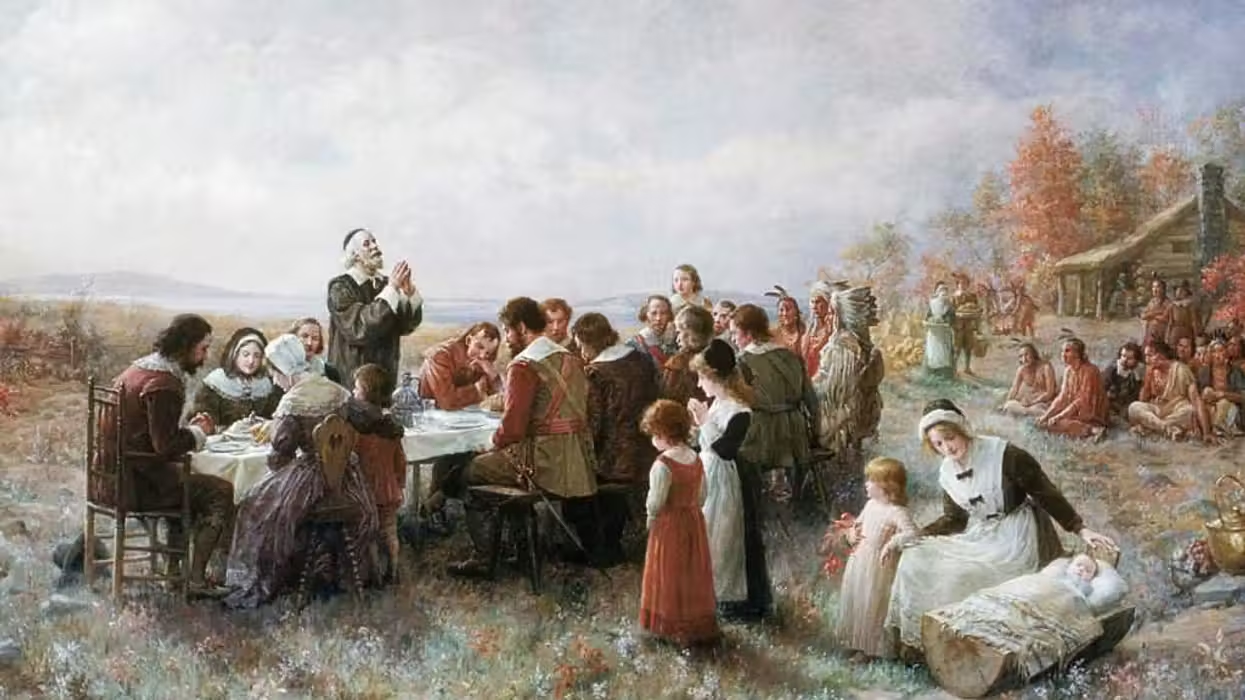 Photo by Barney Burstein/Corbis/VCG via Getty Images
Thanksgiving was meant to be the clearest expression of a nation united by faith, family, and patriotism. It rooted liberty in gratitude and gratitude in God’s providence.
Reagan captured that spirit in 1986, writing that Thanksgiving “underscores our unshakable belief in God as the foundation of our Nation.” That conviction made possible the prosperity and freedom Americans inherited.
Today’s constitutional conservatives must lead in restoring that heritage — not by nostalgia, but by example. Families who teach gratitude, faith, and national purpose build the civic strength the founders believed essential.
A return to gratitude
Thanksgiving calls each of us to humility: to recognize that national renewal begins with personal renewal. Our problems — social, fiscal, and moral — are immense. But they are not greater than the God our ancestors trusted.
That confidence is the heart of Thanksgiving. It is why the Pilgrims prayed, why Congress proclaimed days of fasting and praise, why Lincoln unified the holiday, and why generations of Americans pause each November to give thanks.
Editor’s note: A version of this article first appeared at Conservative Review in 2015.





